
Michigan offers a generous squirrel hunting season which runs from September 15 to March 31, and you don’t have to travel far in the state to find good squirrel hunting opportunities. While I thoroughly enjoy squirrel hunting during the earlier fall season, I also always look forward to wintertime “bushytail” hunting. Due to the recent late deer hunting seasons in January that I enjoyed participating in, from February to the end of March will have me put a frequent focus on squirrel hunting, pending weather conditions, of course. Stormy and blustery winter weather doesn’t offer the most productive squirrel hunting opportunities, and I prefer blue and sunny skies minus the gale-force winds which have been all too common recently. Yep, folks, both squirrels and I tend to prefer fair weather for primetime activities in the woods.
Wintertime bushytail hunting offers its unique challenges, because there are no longer any leaves on the hardwood trees which allows wary and sharp-eyed squirrels to have great vantage points. By the same token, squirrels are far easier to see on a snowy backdrop, and one of my favorite hunting methods is to find a handy tree trunk large enough to keep my body profile from standing out when sitting in front of it. Although you can use a shotgun, I look at this as being a rifleman’s pastime, while seated on a comfortable stool and having handy shooting-sticks for a solid rest, because some shots can be on the lengthy side at small targets.
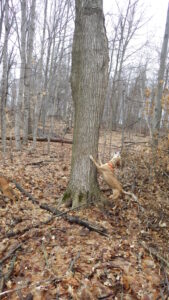
With its eyes locked onto a squirrel, this mountain cur is “barking up the right tree”!
My two favorite squirrel rifles are a scoped Remington semiauto in .22 long rifle and a scoped vintage Ithaca lever-action in .22 Magnum. I call my static position a “squirrel stand” (not unlike buffalo hunters of long ago with their static “buffalo stands”) and I never jump up to retrieve each squirrel I shoot, but instead mark their location to memory, and continue to hold tight. I can state moving in to actively retrieve a dead squirrel each time will put the rest of them automatically into hiding, sometimes for quite a spell, whereas a rimfire-report from a rifle usually does not.
Squirrels had spent the previous autumn busily gathering nuts and shallowly burying them in a special, often random, cache throughout the woods to survive the long winter months (squirrels are known as being one the best forms of natural reforestation because a lot of the nuts they stow away in the ground aren’t always found and are planted just right to germinate and make more trees). They also enjoy searching out and absconding with the other squirrels’ cached nuts, and this means there is a lot of squirrel activity especially on the ground, and this is where I have “sniped” most squirrels while they are moving around on the forest floor.
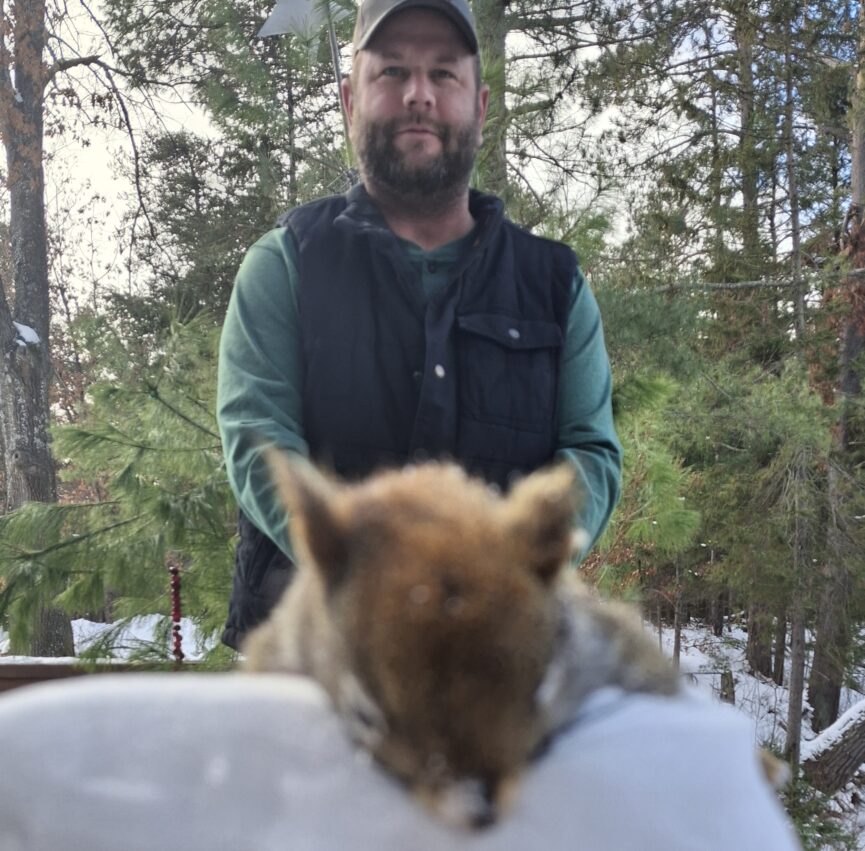
By always having a Michigan fur takers license on hand, I keep an eye out for both foxes and coyotes which are also seeking a squirrel-meal. I’ve discovered even a diminutive .22 long rifle hollow-point bullet properly placed in the lungs will put a smackdown on a tenacious coyote, especially when quickly backed by a couple more shots if needed! Yep, folks, holding tight on a wintertime squirrel stand can sometimes offer special dividends.
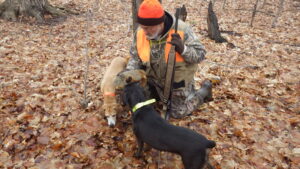
Nothing beats sharing the wintertime squirrel woods with a pair of eager and well trained mountain cur squirrel dogs.
My other very favorite wintertime bushytail hunting method is using squirrel dogs, and unlike a more sedentary squirrel stand, it can be a very active and animated pastime. I own three squirrel dogs; two mountain curs and a redbone coonhound who live to tree bushytails and I have friends who also own squirrel dogs (my German shorthair pointer enjoys joining into the act – any dog with the right attitude can do the job). A good squirrel dog not only hunts by scent, but by sight as well, especially when the squirrel goes up into a tree. Sometimes a squirrel will hold tight in the tree, but they often begin traveling through the limbs to other trees, which the dog keeps an eye on, instead of continually howling up a tree trunk minus a squirrel (aka “barking up the wrong tree”). Unlike many other hunting pursuits using hounds, squirrel dogs tend to keep matters in a smaller area and are much easier to follow.
Because of this expected animation, I often prefer a smallbore shotgun in either .410 or 28 ga, preferably stoked with number 4 lead birdshot, because squirrels are tough and very muscular critters, despite their small size, which can be up quite a way in the tree. I also often use my scoped .17 caliber Gamo air rifle firing lead hunting pellets, which I believe is far safer than a .22 rimfire rifle which has a much longer reach beyond skyline squirrels if the shot misses. As they say, what goes up must come down.
A beauty of a trained squirrel dog is that they will retrieve a downed squirrel and will do a quick finishing “touchup”, if required. When my mountain cur, “Jilly” went in head-on to retrieve her first squirrel which wasn’t quite dead yet, it latched right onto her upper lip. What really ruined the moment for Jilly was when another mountain cur with her ripped the squirrel off! She learned right then what not to do the next time. Yep, folks, squirrels do have sharp teeth which can easily crunch through hard-shelled nuts and know how to use them as a defense mechanism!
Since small game hunting has been falling by the wayside in favor of deer hunting in Michigan, it has been my goal to take youth hunters out bushytail hunting while accompanying animated and often vocal squirrel dogs which isn’t boring at all, as might be the case after a lengthy spell of sitting quiet and still in a deer blind. I believe it is an exciting way to acquaint kids with enjoying a whole new avenue in the great outdoors.
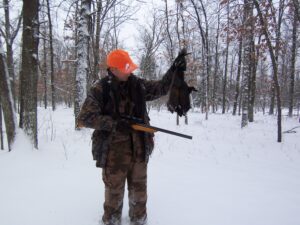
This wintertime bushytail hunter used a static “squirrel stand” to bag his limit of gray squirrels.
Squirrels offer delicious table fare in quite a few recipes (nope, folks, I’ve never wished to fry up squirrel brains, a southern delicacy). I used to skin them in a laboriously slow fashion, and it was a time when I would rather skin ten rabbits instead of one squirrel, but I eventually learned an easier and much quicker technique. Simply sever the tailbone right at the base, but leave the skin still attached to the back. Grasp onto the hindlegs, step on the tail and pull upward, allowing the skin to easily and completely peel right off over the head. All that remains is the skin on the hindquarters, which also easily peels right off using your fingers pulling upward in the opposite direction. Oh my, I discovered right then that I could skin a squirrel much quicker than even skinning a rabbit!
Yep, folks, give me a somewhat fair weather winter day and I will most likely be out bushytail hunting in one form or another.

than 40 years and has had his weekly radio show, “Tom Lounsbury
Outdoors” for more than 20 years. Tom grew up on a farm in
Michigan’s Thumb, and it is where his first outdoor adventures began
as a kid accompanying visiting pheasant hunters into the field during
the “pheasant hunting heyday” of the 1950’s and 1960’s. It is a passion
he still has to this day and being the 4 th generation to own the family
farm, he has put most of it into conservation programs with a focus on
wild pheasants, which in turn helps all wildlife.
Being an outdoor communicator, Tom appreciates all the outdoor
adventures he experiences in different places, and especially the
people he meets in which to share them.
- Fun times enjoying the family farm pond - July 14, 2026
- Suppressing those sudden loud noises during outdoor shootingadventures - July 14, 2026
- The dependable Jeep, an American icon for 85 years and still ticking - July 14, 2026