
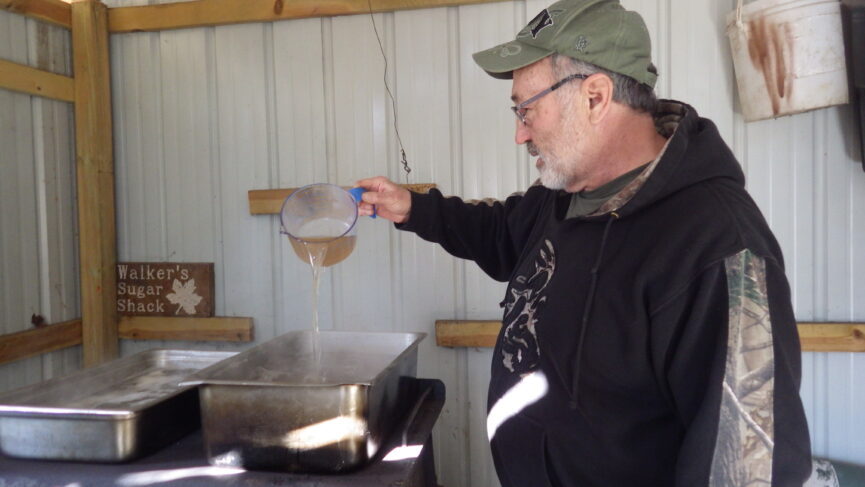
The typical timeframe for gathering sap from tapped maple trees, at least in my neck of the woods, is March 1 to April 1. This year, however, folks I know in the maple syrup world were tapping their trees by mid-February. I’ve also seen times when maple sap hardly ran at all, so it is pretty much up to fickle weather conditions. Last year, the early sap-flow in February caught many folks by surprise, and due to the ensuing balmy weather, which caused maple trees to start budding out sooner than expected, sap-gathering ended in early March. When maple trees start budding out, the sap gets a milky appearance which is bitter. Apparently global warming is the cause for earlier maple sap harvest dates, even in New England and Canada.
From the Colonial period on, maple syrup and maple sugar were an important sweetener for many pioneering settlers in northeastern America and was much more available and less expensive than the processed cane sugar and molasses being shipped in from the Caribbean. For many in wilderness situations, maple syrup and maple sugar were the only form of sweetener, a resource learned from Native Americans. Boiling sap annually at the onset of spring became a necessary part of life in those days, and it was a skill passed on from generation to generation.
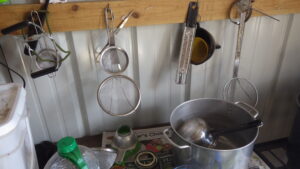
Important items for making maple syrup are a hydrometer, thermometer and strainers.
Today, processed sugar produced from both sugar cane and sugar beets are certainly more commonplace, but for many of us, real maple syrup remains a delicacy which offers a very distinct flavor from our part of the world. The first use to come to mind is for pancakes and waffles, but it does just as nicely on desserts, ice cream and popcorn, as well as an ingredient to many cooking recipes and in marinades for smoked meats and fish. I even like to add it to a hot cup of coffee or tea.
I can readily remember working in a neighbor’s sugarbush when I was in high school. The first chore was selecting trees, with 10 inches in diameter at least being a requirement, and drilling shallow holes in them with a hand drill, and hammering in a hollow metal tap, on which hangs a metal bucket for holding sap. Depending upon the diameter of the tree, this could entail as many as three taps. Then the buckets were hung on to gather the steadily dripping sap. The metal sap buckets had removable lids which kept out debris and precipitation.
Reaching the trees for tapping that year required wading through deep snow. Fortunately, this began to establish trails to the various trees which became more packed while gathering sap with a pair of 5-gallon buckets daily. The trails became slippery with ice, and later with mud and the already touchy footing was also enhanced by tree roots, fallen limbs, ruts and rocks. This was certainly an obstacle course, especially with a nearly full bucket in each hand, while you meandered your way back to the holding tank being slowly towed through the woods by a tractor.
I can remember slipping and falling with two full buckets spilling all over me. As watery as that clear sap appeared, it was still sticky. Hard work, however, kept me warm for the remainder of that afternoon, but I literally had to peel my sticky clothes off when I got home.
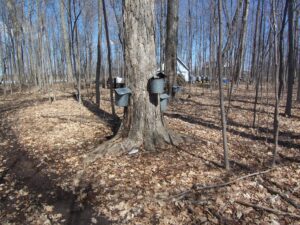
Metal sap buckets on a huge sugar maple tree which is capable of having at least 3 taps and buckets. Maple trees must have at least a 10-inch trunk diameter before it can be tapped.
It was clearly strenuous work, but I thoroughly enjoyed it. There was a constant association with the woods in all kinds of unpredictable March weather, and you literally began to form a personal association with individual trees which you discovered possessed their own unique character. Then there was the sun disappearing as you gathered the last of the sap for the day. A combination of wood smoke and steam from boiling sap escaping from the slotted roof of the sugar shack permeated the woods with an earthy aroma that gathered close to the ground as the temperature dropped and darkness enveloped the woods.
The pale-yellow glow created by a hissing Coleman lantern shining out of the only steam-coated window on the sugar shack was always a beckoning beacon at the day’s end. When you opened the door, you were greeted with a nearly suffocating heat which instantly enveloped you and quickly thawed out any frozen digits. The moist scent of boiling maple syrup was so heavy that you could literally taste it as well, with each breath while the red glow of burning hardwood in the furnace combined with the dense foggy atmosphere to create an eerie flickering along the walls and ceiling.
The steam in the room swirled around you on its way up to the slanted roof slot to escape into an ink-black and star-studded sky to the accompanying music of bubbling, boiling syrup and the snap and crackle of a hot fire. Clearly, there is no other atmosphere quite like it! The best and most productive sap days entail freezing 25-degree nights and thawing 40-degree days. It takes 40 to 45 gallons of sap to make one gallon of maple syrup.
If my coworkers and I were lucky at days end and a fresh batch of syrup was near completion, the boss would drain off a partial cupful for each of us to sip and savor. It was clearly a distinct elixir of spring which sure energized a weary body. To this day I still, on occasion, warm up a mug of genuine maple syrup to sip and savor while fondly remembering those unforgettable physically hard days and the close and constant association with nature in the sugarbush.
When my wife Ginny and I first built our home on bare farm ground, I began planting trees right away, which included maples and black walnuts, that after nearly 5 decades, have attained some pretty decent size. I’ve been pondering about tapping some of the maples, but I’m especially interested in tapping some black walnut trees which provide a rich, very sweet syrup offering a unique nutty flavor. The black walnut sap runs during the same timeframe as with the maples but requires filtering to remove string-like pectin. Yep, folks, I’m really tempted to give it a whirl!
When it comes to harvesting maple sap, there are good spring seasons and not so good spring seasons, all according to the ongoing winter weather which is winding down. Making maple syrup and savoring its flavor is a definite part of the process in enjoying one of nature’s wonderful seasonal bounties. It is clearly the very popular sweet flavor of spring.

than 40 years and has had his weekly radio show, “Tom Lounsbury
Outdoors” for more than 20 years. Tom grew up on a farm in
Michigan’s Thumb, and it is where his first outdoor adventures began
as a kid accompanying visiting pheasant hunters into the field during
the “pheasant hunting heyday” of the 1950’s and 1960’s. It is a passion
he still has to this day and being the 4 th generation to own the family
farm, he has put most of it into conservation programs with a focus on
wild pheasants, which in turn helps all wildlife.
Being an outdoor communicator, Tom appreciates all the outdoor
adventures he experiences in different places, and especially the
people he meets in which to share them.
- Fun times enjoying the family farm pond - July 14, 2026
- Suppressing those sudden loud noises during outdoor shootingadventures - July 14, 2026
- The dependable Jeep, an American icon for 85 years and still ticking - July 14, 2026