
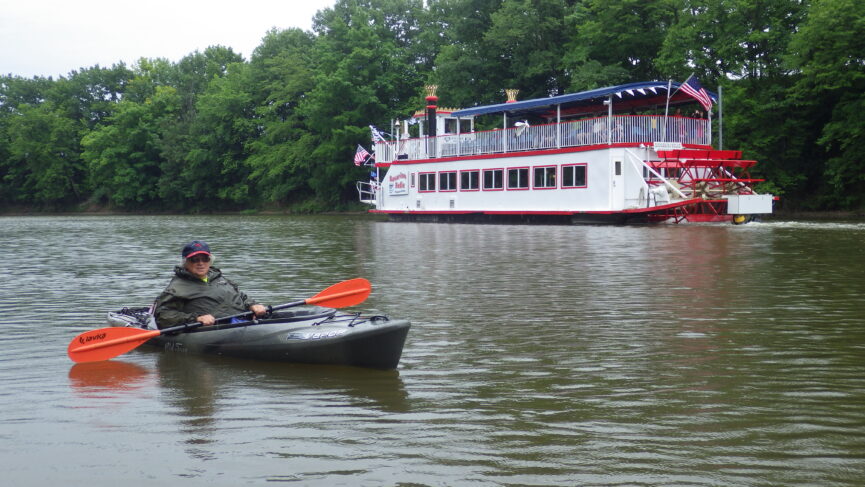
The kayak is a very specialized canoe which was first invented about 5,000 years ago by indigenous Inuit, Aleut and yupik people. It was constructed using a driftwood or whalebone frame that was covered with animal skins waterproofed by animal fat. Called a “qajak” (hunter’s boat), it was used to hunt sea mammals in frigid Arctic waters and was major means for survival in a harsh and often unforgiving environment.
They were tailormade to fit the user who wore a special waterproofed skin jacket called a “tuilik” that was attached to the kayak and prevented water from entering the cockpit during an “Eskimo roll” in which a capsized kayak is quickly up righted, a situation that could readily happen after harpooning sea mammals with the harpoon’s lengthy line attached to the kayak (when required, modern kayaks use a “spray deck” attached around the paddler’s waist to keep water out of the cockpit).
The kayak took a recreational shift in 1865, when British Explorer, John McGregor, formed the Royal Canoe Club in England, a move that would popularize recreational paddling which would continue to develop into what it has become today. The kayak first appeared in the 1936 Olympics in Germany, with whitewater events coming to fruition in 1972.
During the 1980’s, kayaks began to be manufactured using fiberglass and rotomolded plastic, making them more readily available and affordable. During the 1970’s, I was seriously looking at a Made in the USA Kayak called the “Folbot”, that was basically of wood and fabric construction which could be folded compactly for transporting. It was quite streamlined and offered a spacious cockpit which I could see covering all my needs for fishing, hunting and general cruising, but it was a bit pricey, and already owning good canoe, I decided to pass.
A flotilla of kayaks on a river make a very colorful setting.
Although I’m a dedicated traditional canoe fan, I’ve kept my eye out for just the right kayak because I’ve used my share of rentals to realize they are highly maneuverable, possess an amazing shallow draft and are way more wind resistant than the typical canoe (if you have ever paddled a traditional canoe against a strong headwind, you know what I mean). I have even paddled sea kayaks in Lake Superior which I much enjoyed, as it offers a contact with the “big water” in very personable and tranquil way. Not being a tiny tot, I found out right away that when it comes to mostly enclosed kayak cockpits, I best pick and choose what I get in. A “fits-all” rental I used on the AuSable River was a tad too tight when I literally squeezed into it. Yep, folks, it’s a bit embarrassing when the paddle-trip ends, and it takes two kayak rental employees to pry you and the kayak apart, just like pulling off a stubborn boot!
Kayaks began to steadily get a strong following on Michigan’s bountiful waterways and quickly became a regular offering at canoe liveries. What also helped in popularity was kayaks being constructed of very durable polyethylene plastic in every style, color and size imaginable as well as becoming quite affordable to purchase. Michigan discovered that ecotourism had become a major part of the state’s tourism industry, with paddling its bountiful waterways quickly becoming known as very popular “silent sport ecotourism”. It is why the state now has over 3,000 miles of official water trails. Municipalities with ready access to rivers and lakes soon discovered such was a distinct boon to their local economies, with party stores, restaurants and gas stations being used by visiting tourists.
Today, it is not unusual during the paddling season to see one or more highly portable kayaks on top of vehicles. Paddling is not just a summer pastime, because spring offers its own unique atmosphere of trees and shrubs greening, blossoms popping out and all is combined with the earthy scent of everything waking up after a long winter. Fall has its own distinct offering and nothing beats a serene color tour from a canoe or kayak. All three paddling (aka silent sport) seasons often offer plenty of wildlife sightings which can usually entail a birdwatching paradise.
A very significant growth in the silent sport pastime occurred during the pandemic, when a whole lot of folks wanted to avoid crowds and get back in touch with nature. Affordable kayaks became a very popular option, and I can remember with such becoming in demand to even including backorders.
An event which really impressed me about kayak performance was when a large portion of my nearby Cass River became an official water trail and to commemorate matters, fellow members of the Cass River Greenway and I decided to paddle down the river from Cass City to Wickes Park in Saginaw. This would take five-day trips to accomplish, and on Saturdays to allow kids to be involved. Because kayaks, which come in all sorts of styles and colors, made up the majority of watercraft, there was quite a colorful flotilla going down the river.
Official Water Trails feature kayak/canoe launches at regular intervals to allow easy and convenient access to a river.
When we launched from Cass City on the first morning, I had a cameraman filming the event sitting in the front of my Sportpal canoe. Unbeknownst to me, he had overloaded the bow of the canoe with fair-sized spare batteries for his camera, which made steering on my part in the stern a tad difficult, and we soon ended up stranded on top of a large boulder in a full-rushing rapids. That is when two friends who were ahead of me in their maneuverable kayaks, turned around and skillfully paddled back upstream through the roiling torrent and rammed my canoe off the boulder using the bows of their durable kayaks! Nope, folks, I sure couldn’t have duplicated that feat with a traditional canoe.
From Caro downstream to Saginaw, we had the generous assistance of Frankenmuth Kayak Adventures (kayakfrankenmuth@gmail.com) that furnished kayaks as well transferring everyone’s watercraft to a large trailer whenever needed. Yep, folks, from then on for the remainder of the trip I was an avid kayaker and able to try something different on each leg of the journey. The most comfortable kayak of the lot, for me at least, was designed for fishing, which was very stable to get on and off as easy as you please. Its seat, which included cupholders, was like sitting in a lawn chair and there were all sorts of means for holding fishing tackle and rods. The only problem, it was more designed for fishing and not so much for river-cruising and I had my hands full in double-paddling to keep up with the other more streamlined kayaks. But I still enjoyed the ride!
When it comes to paddling, either in a kayak or traditional canoe, I’m pretty much a dyed in the wool riverman, and prefer the tranquility which can be found in that atmosphere. Having seen how things have transpired on Michigan’s bountiful waterways, there is little doubt in my mind that the kayak has become the reigning king, and rightfully so.

- The kayak – today’s king of Michigan’s bountiful waterways - March 30, 2026
- WGD Podcasts 2.0! - January 17, 2026
- There’s More To Be Said - May 22, 2025