
Being a farm kid six decades ago, I decided to take up fur-trapping
during the winter to supplement my meager allowance I received for doing
daily chores. My trapping primarily took place in our nearby orchard (for fox
and raccoons) as well as along the drainage ditch (for fox, raccoons,
muskrats and mink) which runs across the center of the farm. Checking my
traps daily was something I enjoyed and looked forward to because I was
always excited to discover what might be in them, and you learn a whole lot
about the wild critters you are after when you have a trapline.
Matters were going quite smoothly that winter until a record amount
of snow hit the Thumb and would stay until spring. Wading and sometimes
wallowing through often waist-deep snow became a chore, and there were
times I had created a well-packed trail along my trapline which allowed
easier going for a day or two, but then another storm, not to mention drifting
snow, would fill everything back in again. That is when I mail-ordered a set
of snowshoes from LL Bean in Maine.
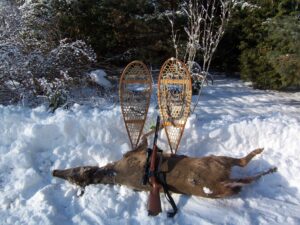
Author displaying “his catch” of the day while navigating the deep snow with a muzzleloader.
Yep, folks, I was mighty excited when that long box finally arrived and
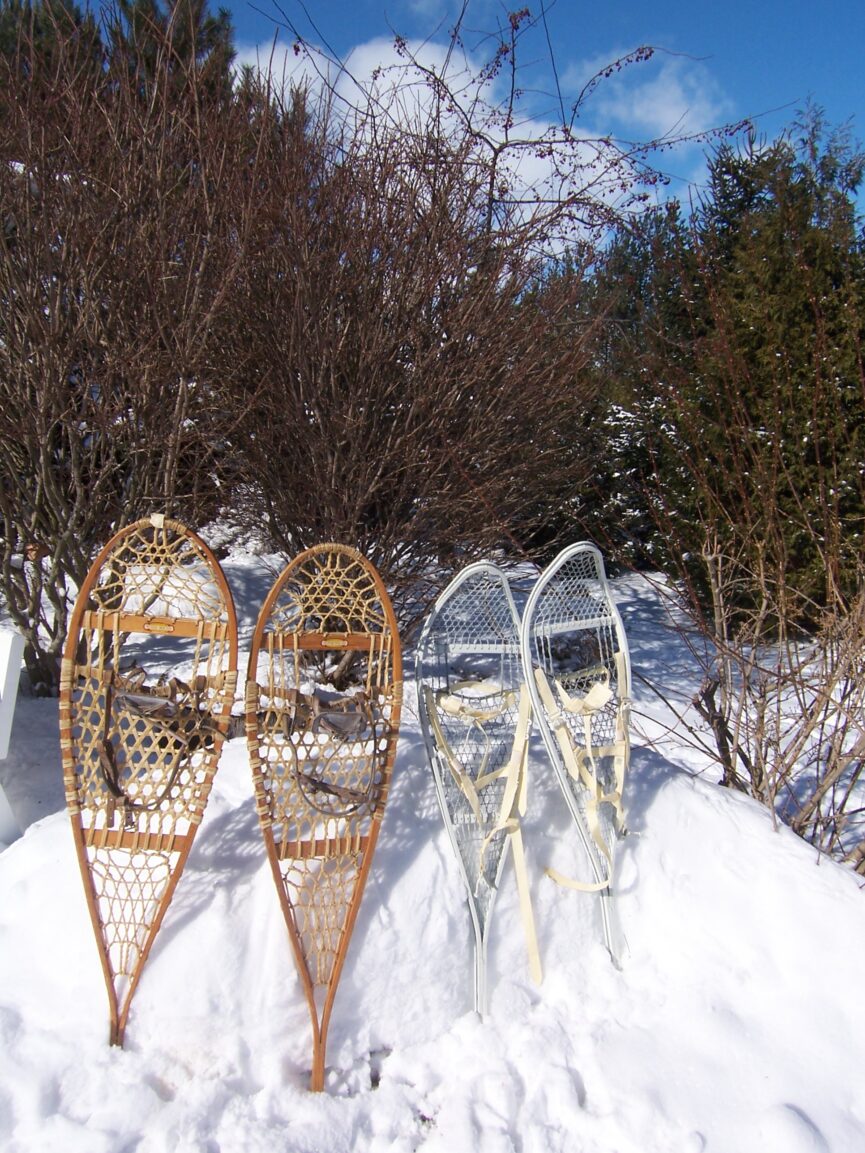
I unwrapped matters. The snowshoes were the typical wide
“Maine/Michigan” design which could carry a heavy load over deep snow
and were constructed with rawhide webbing lashed to wooden ash frames
and were held on with rugged leather foot-harnesses (the unique earthy
smell of varnished rawhide and oiled leather which I smelled opening the
box is a fine memory with me still). This was an ageless design created by
indigenous people to deal with and survive in the deep snows of the
northern wilderness. The webbing is woven in a spiderweb manner which
effectively transfers weight and allows snow that would otherwise collect on
top of the snowshoe to readily drop through. The webbing pressing into the
snow also allows for natural traction when going up or down hills and the
long tail dragging on the back keeps matters tracking in a straight line.
It didn’t take me long to strap matters on and go for a “test-drive” on a
big snowdrift near the farmhouse. Learning to use snowshoes isn’t that
difficult and all that is required is to stride in a manner wide enough to allow
the snowshoes to slide easily along side by side, and a key is to lift your
foot only high enough to slide the snowshoe forward, because it is less of a
strain and wasted energy than trying to actually walk “high stepping” with
them. My main learning issue was turning around in the about face manner
and crossing the snowshoes up and creating a face-planted snow angel!
Yep, this is when a controlled swinging high step is usually required.
Once I became fully acquainted with my new snowshoes, I was soon
skimming along the top of deep snow to regularly check my trapline, as well
doing some rabbit and fox hunting along the way with my single-shot .22
rifle I always had on hand. That was the beginning of a long and
dependable association with that set of snowshoes, which are still ticking
today. The only maintenance required is to occasionally add a coat of
varnish over both the ash frames and rawhide webbing, and when not
being used the snowshoes look great stored on my den wall.
Along the way, I purchased a used set from an elderly friend of mine
who no longer used them, which were the same ash and rawhide
construction, but of a narrower and longer “cross-country” design. The
cross-country design works great for crossing open country and on trails
but is a tad cumbersome to negotiate denser cover. I wore them once into
some swampy habitat to drive deer to my son who was wearing my more
versatile Maine/Michigan set, and it was an educational moment for me.
After tripping and getting hung up in the low-lying brush, I soon unstrapped
the lengthier affairs, put them over my shoulder and waded the rest of the
way.
There are tailless snowshoes designed for negotiating brushy covers,
and modern high-tech snowshoes tend to follow along those lines. The
modern snowshoes usually feature “claws” to gain traction when required,
and they are noisier when on the move than the webbed and ash-frame
models. These days, neoprene is often used instead of rawhide for
webbing, I guess because some assume it is tougher and more
maintenance free. However, the neoprene can fray on the edges after
extended use, whereas rawhide holds up, and I have 60-year-old
snowshoes to prove it. Yep, folks, I’ll stick with the centuries old, time-
proven ash and rawhide versions.
I purchased some military surplus snowshoes on sale, which feature
magnesium frames and steel cable webbing that can do the trick, but they
lack that nostalgic and warm feeling I get while using my old snowshoes.
I’m none too interested in the aluminum-framed and plastic-covered high-
tech versions which are quite popular, due primarily to affordability, and
they do work quite well. I just know and have faith in what works for me
after years of use.
Quality ash-framed snowshoes with either rawhide or neoprene
webbing, are made by Iverson Snowshoes in Michigan’s Upper Peninsula,
and come in a variety models. I’ve had my eye on the Iverson Modified
Bear Paw, with rawhide webbing, which I believe would be a real
maneuverable crackerjack in the brush for wintertime rabbit hunting, one of
my favorite outdoor pastimes. Then there is also squirrel hunting and
predator hunting in the same snowy environment.
We’ve had some rather mild winters in Michigan of late, but I have a
sense this year might be a bit different, and fickle weather matters have
certainly been up and down. It seems to be a one day at a time issue.
Whenever snow depths reach a certain point, snowshoes sure work
for me by allowing me to effectively walk on top of the snow instead of
having to wade and slog through it. They are ready to go whenever
needed!

than 40 years and has had his weekly radio show, “Tom Lounsbury
Outdoors” for more than 20 years. Tom grew up on a farm in
Michigan’s Thumb, and it is where his first outdoor adventures began
as a kid accompanying visiting pheasant hunters into the field during
the “pheasant hunting heyday” of the 1950’s and 1960’s. It is a passion
he still has to this day and being the 4 th generation to own the family
farm, he has put most of it into conservation programs with a focus on
wild pheasants, which in turn helps all wildlife.
Being an outdoor communicator, Tom appreciates all the outdoor
adventures he experiences in different places, and especially the
people he meets in which to share them.
- The kayak – today’s king of Michigan’s bountiful waterways - March 30, 2026
- Connecticut Valley Arms – celebrating 55 years and going strong with continual new products and innovations - March 18, 2026
- Silence Can Be Golden - March 15, 2026