
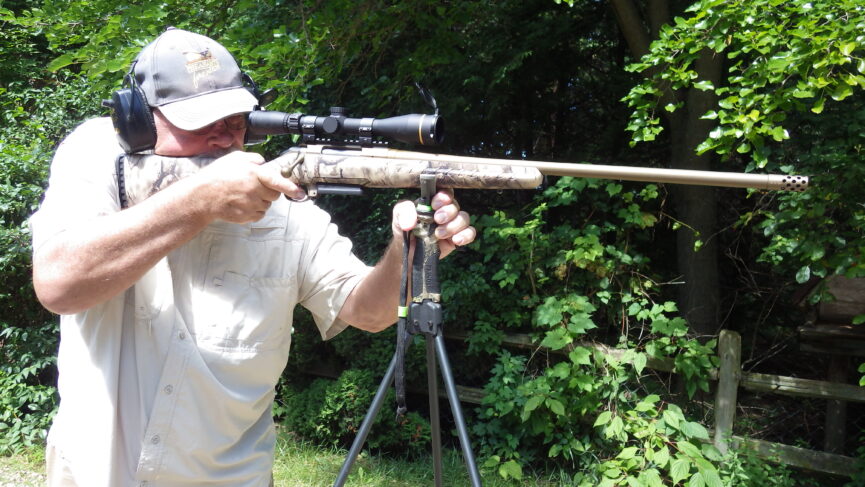
During the early 20th century, deer hunting had been put on hold in southern Michigan for quite a while to allow whitetail deer numbers, which had previously been decimated, to rebound back. Its first deer season occurred in 1948, and because state officials believed too many hunters would be crammed together on the smaller state game areas found in southern Michigan, it was determined to establish what would become known as the “shotgun zone” for what they thought were safety reasons. The first couple of seasons allowed only buckshot to be used, but eventually shotgun slugs would be also allowed, as well as .22 rimfire rifles (which were eventually and fortunately banned for deer hunting in Michigan in 1968).
Creating the shotgun zone no doubt seemed like a proper move at that time for the perceived safety factor, but it didn’t have much to do with reality and actual ballistics. Buckshot is only ethically effective as a group of pellets to 40 or 50 yards, and in heavy cover for the close-range deer hunting it is designed for, it does a decent job I’ve personally relied upon and still do. However, although not accurate by any means, a stray double aught (.33 caliber) lead pellet is still lethal to well over 100 yards, shotgun slugs can reach out lethally at least five times that far and a .22 rimfire bullet also has a lethal range of over a mile. In my opinion, the reality is that Michigan officials back then should have left matters regarding firearms used for deer hunting as being status quo statewide. However, dealing with public perception is very often a mitigating factor, whether it deals with accurate facts or not.
My first Michigan shotgun zone deer season occurred in 1963, and since then I’ve seen the steady transition to what is allowed today. I can remember when muzzleloading rifles were first allowed in the shotgun zone during the mid-1960’s, and the debate leading up to it was regarding safety when comparing the lethal range of projectiles travelling down smooth versus rifled barrels. Fortunately, it was decided that projectiles spinning down rifled barrels were far more accurate and effective than those simply sliding down smoothbore barrels and thus safety wasn’t an issue. However, it would take another couple decades before rifled shotgun barrels, for all the same common-sense reasons, were finally allowed for deer hunting in the shotgun zone.
The Natural Resources Commission (also known back then as the Conservation Commission) was first formed in 1922 and was a 7-member panel appointed by the Governor, to review matters relating to conservation, including hunting and fishing and make recommendations. Final decisions were then made legislatively by politicians and matters could be prone to lobbying and other influencing factors. However, public input has always played a major role in the progression of firearms for deer hunting in southern Michigan, not to mention the rest of the state as well. An example is allowing black powder substitutes and conical bullets in the mid-1980’s for muzzleloader hunting, which in turn created the modern inline evolution, allowing for very accurate shot placement at much longer ranges. I can remember when handguns were allowed for deer hunting in the shotgun zone during the same timeframe.
What really gave some teeth in making decisions was Proposal G which was passed in 1996, that gave the NRC the absolute authority to rely on sound science and facts, and not unrealistic emotions in regulating hunting and fishing. The crux to this was organized animal rights groups wishing to ban using dogs for bear hunting in Michigan. It didn’t take much effort to read between the lines and realize this would eventually include using all dogs for any sort of hunting. Quite an ingenious ploy, really, going after the emotional factor while muddying up the waters during the heated process.
Yep, folks, being an outdoors writer supporting Proposal G, I sure received my share of obviously animal rights-organized “hate mail”, which didn’t bother me a bit, because it let me know I was hitting an essential chord!
What really stunned and left me in utter euphoria was in June 2014, when the NRC changed southern Michigan’s shotgun zone into the limited firearms zone, allowing straight wall cartridges of set dimensions for deer hunting that fall. In my opinion it was about time, and a start in the right direction! It would change the entire complexion of deer hunting in southern Michigan from then on which was truly appreciated and enjoyed by a whole lot of avid deer hunters, me included.
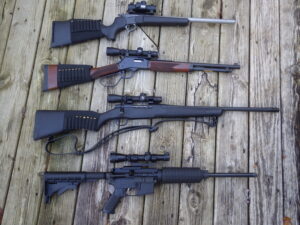
When the Limited Firearms Zone came into being in 2014, rifles such as these using straight wall cartridges changed the entire complexion of deer hunting in what was once known as Michigan’s long standing “shotgun zone”.
From the onset, I’ve been testing at the shooting range and also in the hunting field, several straight wall deer rounds including .44 Magnum, .450 Bushmaster, .350 Legend, .360 BuckHammer, .41 Great Lakes and .400 Legend. I consider these to be midrange calibers, meaning they offer a relatively flat trajectory out to 200 yards or so, which is quite admirable. Some rounds drop like a rock from then on but still have enough energy to be lethal out to 300 yards or more, if the shooter thoroughly understands the rainbow-shaped trajectory. I’ve noticed the optimal goal of newer rounds surfacing is to reach out even a bit further and flatter. However, with most deer being taken by hunters in Michigan at 100 yards or less, I don’t feel under gunned when using my .44 Magnum lever-action Henry Carbine which shoots relatively flat out to 100 yards, and it can tackle matters to 150 yards, my maximum range, where it features an 8-inch drop.
The recent NRC meeting held in Gaylord on May 13, 2026, was a hallmark occasion for me when the commissioners passed eliminating the limited firearms zone in southern Michigan and blanketed the entire state with the same rules for the firearms deer season as has long been in the Upper Peninsula and northern Lower Peninsula, beginning this year. Any legal centerfire rifle caliber, which includes bottleneck cartridges, can be used statewide for deer hunting. The only exception is that .22 rimfire or smaller rifles still cannot be legally used for deer hunting in Michigan. In other words, what has been legal for deer hunting “up north”, is now legal in southern Michigan, a wonderful fact I truly do appreciate.
Although this new change has been long in coming down the road, step by step, all I can say once again folks is, yep, it’s about time. I have a vintage Model 141 Remington pump rifle chambered in .35 Remington (a very functional mid-range bottleneck cartridge which is my longtime favorite combo for black bear hunting) that I’m really looking forward to using for hunting local whitetails this fall. I’m pretty sure there are a lot of deer hunters in the former limited firearms zone, happy to also bring out some fine deer rifles (that use bottleneck cartridges) which have been idly gathering dust in gun cabinets or safes.
I must admit I have a couple more rifles also begging me for more attention and I’m looking forward to giving them all a whirl this fall!

than 40 years and has had his weekly radio show, “Tom Lounsbury
Outdoors” for more than 20 years. Tom grew up on a farm in
Michigan’s Thumb, and it is where his first outdoor adventures began
as a kid accompanying visiting pheasant hunters into the field during
the “pheasant hunting heyday” of the 1950’s and 1960’s. It is a passion
he still has to this day and being the 4 th generation to own the family
farm, he has put most of it into conservation programs with a focus on
wild pheasants, which in turn helps all wildlife.
Being an outdoor communicator, Tom appreciates all the outdoor
adventures he experiences in different places, and especially the
people he meets in which to share them.
- Fun times enjoying the family farm pond - July 14, 2026
- Suppressing those sudden loud noises during outdoor shootingadventures - July 14, 2026
- The dependable Jeep, an American icon for 85 years and still ticking - July 14, 2026