
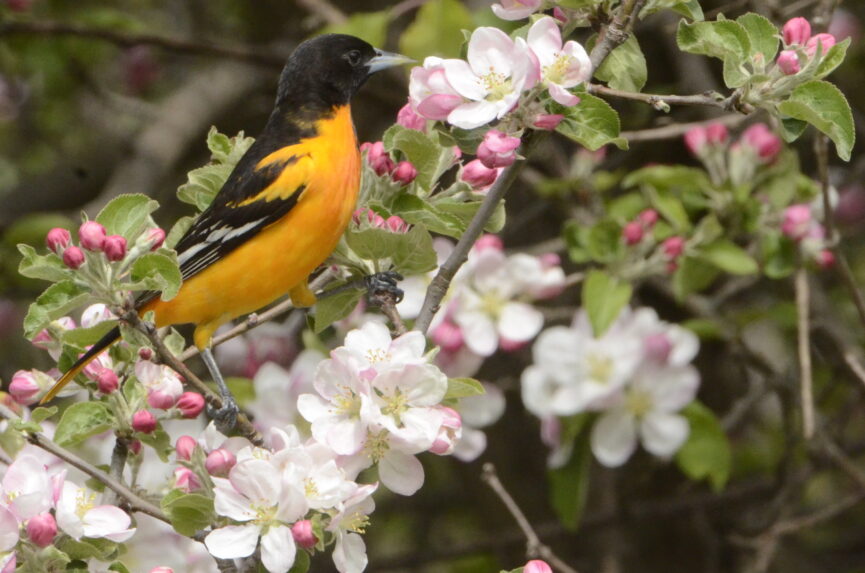
In my opinion the robin gets too much credit for being the harbinger of spring. Sure, most robins migrate each fall from Michigan to warmer places for the winter, but a few do remain behind in brushy creek and river bottoms and make an occasional appearance like a single bird or two here and there to confuse folks as to whether we are in for an early spring. I saw a couple robins on my farm a couple months ago feeding on small crabapples in our yard, back when the sugar maple sap began flowing in mid-February, and I’m pretty sure they weren’t migrants. Male red-wing blackbirds and grackles are usually the first to arrive, but spring is usually still a ways off, and this year has been a rollercoaster ride with all the ups and downs of weather, not mention unbelievably strong winds on a regular basis. Yep, folks, I’ve gotten tired of having that windblown look after being outdoors!
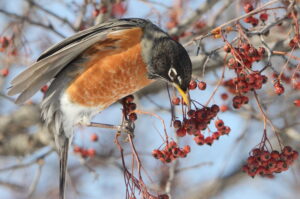
The robin is the official Michigan State Bird, but is only a part time resident of the state, whereas the chickadee is a full time resident through thick and thin.
It was an early spring arrival affair which gave the newly returning robin a distinct boost in becoming our state bird. Back in the 1930’s, a Michigan politician held a voting contest in the Detroit area to see what the most popular bird was, and thus become the state bird. The chickadee had a strong lead, because it is a very friendly and often bold little bird which always has a dependable presence the year round (I had one land on my shoulder the other day to obviously urge me on and complain a bit while I was refilling an empty birdfeeder).
Just as the contest was about to end, robins suddenly arrived in large numbers, and no doubt spring-fever-afflicted city folks gave the robin a clear jumpstart in the poll. It was a real close race, but the robin won, unfairly in my opinion due to its grand entrance from southerly places elsewhere. I personally would like to see the chickadee become our state bird, instead of the fair-weather robin. But that is me, being in the outdoors enough to know the chickadee wins this status hands down. Yep, folks, the robin is a beautiful songbird, and I always appreciate their annual arrival, but I don’t believe it has earned the notable “State Bird” prestige it gets.
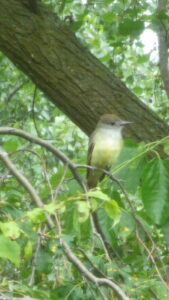
This dusky-capped flycatcher from Mexico suddenly appeared on a branch in front of Tom Lounsbury’s upstairs living room window and probably had an offcourse lift from a hurricane on the Gulf of Mexico last summer. It is most likely the first time a dusky-capped flycatcher has ever been seen in Michigan.
A true harbinger of spring which migrates back to Michigan is an unlikely suspect, which is the turkey vulture. I saw a large flock soaring around on rising thermals above my farm during one our somewhat balmier days last week, which gives me some hope about spring arriving sooner or later. However, I don’t get too comfortable about spring having really “sprung” until I start seeing Baltimore orioles and hummingbirds, which generally show up around the same timeframe in late April or early May. My wife, Ginny, and I usually put our nectar feeders out in late April to greet any new arrivals, and it is a real joy when we see them finally arrive after their long northerly journey. We have orchard orioles showing up as well, with the males being drabber and a bit smaller than the brightly colored male Baltimore orioles.
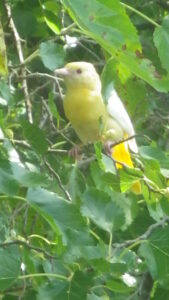
This rare-colored robin arrived to dine on the mulberry tree in front of the Lounsbury living room window and featured a form of albinism, including pink eyes, bill and feet.
In the meantime, I was delighted when the Fish Point Wildlife Refuge in the Thumb began filling up with tundra swans and other waterfowl species, including all sorts of ducks in early March. A visit there to witness matters will surely bring on a bout of spring fever! I also sighted my first “cackling geese” in a field not far from our home, which resembles a small Canada goose, and is about the size of a mallard duck. In fact, my friend, naturalist Myles Willard of Mayville, who is an avid birdwatcher and photographer (and has written several books on the topic) says he has never seen so many different goose species in his frequent travels around the Thumb. This includes cackling geese, snow geese – both white and blue, white-fronted geese (aka speckle-bellies) and even the Ross’s goose, which is the smallest of the three white goose species found in North America. I saw a flock of Ross’s geese last spring on the Cass River, and to the uninitiated, they look like a flock of white ducks, including much shorter necks than the larger snow geese.
Myles Willard has also seen the unusual arrival of some unique raptors which include three western hawk species – a Swainson’s hawk, prairie falcon and a large ferruginous hawk which sometimes gets confused as being an eagle. Also in the mix were some Mississippi kites, broad-winged hawks and red-shouldered hawks. Myles thinks all the above could possibly be the result of the consistently strong winds we’ve been experiencing.
This reminds me of two very rare-for-Michigan bird sightings I had from my living room window last July, with them landing in nearby tree limbs. The first bird I saw was a dusky-capped flycatcher from Mexico, of which I was able to take a couple dandy pictures of.
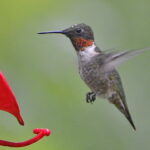
When hummingbirds and orioles arrive, spring has sprung for sure.
The second arrival to show up during the same timeframe was a southern US-based male boat-tailed grackle which is about the size of a crow, and I believe that the hurricanes near the Gulf of Mexico last year might have blown both birds way off course.
April is a good month for birdwatchers to visit the tip of the Thumb near Port Austin, especially whenever there is a south wind. Turkey vultures and a whole combination of raptors, including both golden eagles and bald eagles gather in large flocks and can be seen soaring all over the sky, which is quite a sight to behold. Myles Willard has seen times when there were more than 400 turkey vultures clustered up together and soaring around on uplifting thermals. Some of these birds are waiting for just the right tailwind to fly across Saginaw Bay, because once they get over the cool water, they lose the thermal lift they had when flying above the ground.
Truthfully, folks, I’m an avid birdwatcher still in learning process, but I sure do enjoy always learning and seeing something new and different, even if only from the big window in my living room.

than 40 years and has had his weekly radio show, “Tom Lounsbury
Outdoors” for more than 20 years. Tom grew up on a farm in
Michigan’s Thumb, and it is where his first outdoor adventures began
as a kid accompanying visiting pheasant hunters into the field during
the “pheasant hunting heyday” of the 1950’s and 1960’s. It is a passion
he still has to this day and being the 4 th generation to own the family
farm, he has put most of it into conservation programs with a focus on
wild pheasants, which in turn helps all wildlife.
Being an outdoor communicator, Tom appreciates all the outdoor
adventures he experiences in different places, and especially the
people he meets in which to share them.
- Fun times enjoying the family farm pond - July 14, 2026
- Suppressing those sudden loud noises during outdoor shootingadventures - July 14, 2026
- The dependable Jeep, an American icon for 85 years and still ticking - July 14, 2026