
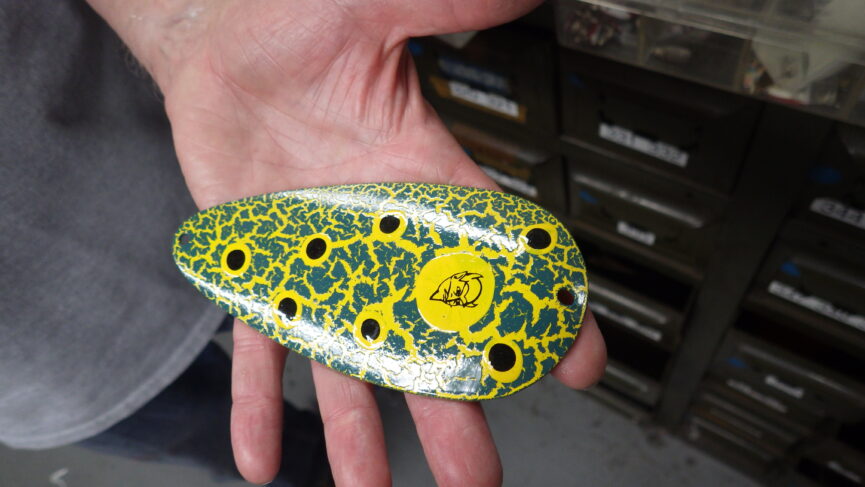
The family farm rests atop a range of hills above the Cass River. Whenever I had any free time as a farm kid during the summer, my favorite fishing holes were only a 10-minute bicycle ride away. My fishing gear was on the simplistic side, featuring a Zebco 202 spin casting rod and reel and only a couple red and white Eppinger dardevle lures, one small and the other medium sized. Nothing more was needed to catch rock bass, smallmouth bass and northern pike.
A beauty of dardevle lures is they offer the perfect weight for accurate casting with some decent reach. Their wobbling action upon retrieval is a distinct attractant to both bass and pike. To this day, the red and white dardevle in various sizes remains to be my favorite. However, while on a fly-in fishing trip in Ontario where I targeted large northern pike, I discovered the Eppinger bright yellow “five of diamonds” dardevle was the ticket. Maybe it had something to do with darker water of that wilderness lake, but I ended up using the “five of diamonds” almost exclusively, despite a wide selection of other lures. It was pike fishing in this sort of wilderness atmosphere which started the Eppinger legacy.
While on a fishing trip in the Ontario wilderness in 1906, Detroit taxidermist Lou Eppinger had hammered out a brass fishing spoon and was testing it. Thin in the middle and heavier around the outer edges, he discovered the concave, 2-ounce lure offered the perfect wobble in the water which readily attracted northern pike. Because his taxidermy work provided only a seasonal income, Lou had been selling fishing tackle out of his shop in Detroit to supplement matters. By 1910 this expanded to become a full-service outdoor sporting goods outfitter. After a bit of tweaking and field testing, he would begin selling his specially designed “pike spoon”, which he called the Osprey, and it quickly became popular with avid anglers.
In 1918, Lou’s nephew, Ed Eppinger, joined in to help with a steadily growing business. Ed would prove to be a master at promoting and marketing the newly developed fishing lure, and at the end of World War I, the name Osprey was changed to “Dardevle” (aka dare devil), in honor of the U.S. Marines who had fought at the Battle of Belleau Woods in France. The Marines had fought with such effective ferocity that the Germans called them “Teufel Hunden” (Devil Dogs). The spelling change for the new lure from devil to devle was designed to avoid offending any church goers. The original dardevle color was black and white and the very popular red and white color most folks can identify with came about several years later. There is no question that the Eppinger Dardevle in its many forms would become, and remains to be, one of the most iconic fishing lures in the world.
Over time, Lou would hand matters over to his nephew Ed, who would take over the company in 1958. Ed’s daughter Karen would take over in 1987 and remained there until recently. Karen’s daughter, Jennifer, is now in charge.
I had always wanted to visit the Eppinger factory in Dearborn to see how the wide variety of lures were manufactured, and my wife, Ginny, who is also an avid angler, and I did just that a couple years ago, thanks to an invite from John Cleveland, head of marketing for Eppinger. I’ve known John for several years, and besides skillfully marketing matters, he is a worldwide angler and an award-winning outdoor writer. He has fished in wilderness places which most folks can only dream about!
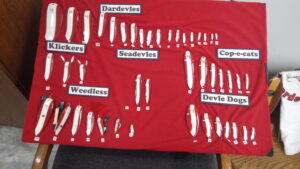
Eppinger Lures come in all sizes and colors to meet the needs of avid anglers
Thanks to our GPS, we were able to locate the factory on a busy city street. Other than a sign above the front door, the brick building was nondescript gray in color. When Ginny and I went to the front door, a sign in the window said to go to shipping, to enter. What we encountered when entering was a literal beehive of activity. Several ladies were all hard at work doing their individual tasks around the main floor, and stacks of colorful lures were in evidence at the different stations.
Despite overseeing Marketing, John Cleveland greeted us wearing work clothes dabbed up with multi-colored paint, which stated he did a whole lot more for the business than just sitting behind a desk. We would discover he was a jack of all trades in assisting wherever needed during the manufacturing process and was the only man working with a skeleton crew involving several ladies, which I found to be an amazing fact, especially when you consider Eppinger produces over two million lures annually for a worldwide market. It was apparent everyone knew what to do and matters were performed in a very natural atmosphere entailing cohesive teamwork.
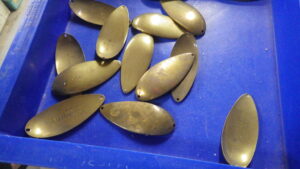
pre-formed Made in USA brass ready for making into a variety of Eppinger lures.
When our start-to-finish tour began, John informed us that it would be like a tour of Greenfield Village, because the production process and most of the equipment hadn’t been changed since the very beginning. An example was a 1938 rivet machine from a shoe factory which used a leather fanbelt. It performed the task of putting grommets in the holes of lures, one at a time. I was absolutely amazed at how much handwork went into each and every Eppinger lure, including custom painting by hand, much of what is done by the company president, Jennifer, who when I first met her, was at her desk checking orders, but wearing a work-apron covered with various paint colors, and the next time I saw her was in the paint room doing custom hand-painting, one lure at a time.
It became very clear that the work ethic at Eppinger is, if it works, don’t change, a fact which really amazed and impressed me. Yep, folks, it clearly works for them!
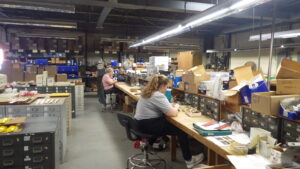
The final product is assembled by hand, one at a time
The lures are made of “half-hard” brass, which is just right to form into shape, whereas “quarter-hard” is too soft, and more than half-hard is too hard. In keeping with “Made in the USA”, getting the preformed lures is outsourced to a small company in northern Minnesota, and are ready for the final preparation, including the paintjob. The paint used is “aerospace” quality and while the paint on a dardevle might chip, it can’t be scraped off. According to John Cleveland, the only things which can affect the paint are insect repellent and sunscreen, as well as laying plastic worms on the lures can cause a chemical reaction, something to keep in mind when it comes to storing items in the tackle box.
Certain production techniques never change, and customers wouldn’t know the difference, if the eyes of the “redeye wiggler” were made of more economical plastic, but Karen Eppinger insisted that genuine red crystal glass from Czechoslovakia be used according to the original design.
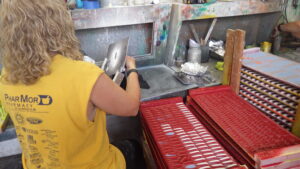
Eppinger Lures are custom-painted one at a time
Lou and Ed Eppinger were inducted into the Freshwater Fishing Hall of Fame in 1990, and Karen Eppinger was also inducted in 2023. These honors are well deserved by a family-run business which always puts quality at the forefront of all else.

than 40 years and has had his weekly radio show, “Tom Lounsbury
Outdoors” for more than 20 years. Tom grew up on a farm in
Michigan’s Thumb, and it is where his first outdoor adventures began
as a kid accompanying visiting pheasant hunters into the field during
the “pheasant hunting heyday” of the 1950’s and 1960’s. It is a passion
he still has to this day and being the 4 th generation to own the family
farm, he has put most of it into conservation programs with a focus on
wild pheasants, which in turn helps all wildlife.
Being an outdoor communicator, Tom appreciates all the outdoor
adventures he experiences in different places, and especially the
people he meets in which to share them.
- Fun times enjoying the family farm pond - July 14, 2026
- Suppressing those sudden loud noises during outdoor shootingadventures - July 14, 2026
- The dependable Jeep, an American icon for 85 years and still ticking - July 14, 2026