

When growing up as a Thumb area farm boy, I rarely ever saw a tick attached to anything. I do remember seeing one attached to the forehead of one our barn cats, and the big tick was very visible because it was fully engorged with blood and all puffed up like a balloon. The cat wasn’t even aware it was there until I pulled the lethargic tick off with my fingers, threw it on the hardwood barn floor and stomped it into a messy splatter. I spent a whole lot of time outdoors in both work and play back then and never discovered any ticks on me, but times are changing.
My first real tick adventure happened while hiking in the Upper Peninsula’s Huron Mountains during springtime, and ticks had become epidemic there that year. Using common sense, the bottom of my pantlegs were stuffed into my boots and I was wearing long sleeves and a sensible hat. Continually brushing ticks off my outer garments (it pays to wear light-colored clothing to more easily see ticks), despite also being sprayed all over with insect repellant, was a steady occurrence. Ticks don’t always hug close to the ground but can also be a bit higher up clinging in the overhead foliage and waiting to hitch a ride on whatever brushes past. It didn’t take me long to put a bandana around my neck to prevent them from entering near my shirt collar. I can remember when the same thing began to happen while I was spring turkey hunting in the northern Lower Peninsula stating that ticks were steadily spreading their range southward.
Thanks primarily to global warming and milder winters creating the perfect environment (aka storm), ticks have become a serious statewide problem, and more so in recent years. I thought last year was as bad as could ever be, but it doesn’t hold a candle to what I have witnessed thus far this spring. Michigan’s typical tick season runs May – November, but I’ve seen them still being a problem well into December and with ticks being able to easily survive any sort of deepfreeze, I’ve noticed this year’s tick season was already back in full swing by March.
Michigan has 20 different tick species, and I know a tick when I see it, but I’m only familiar with two of the most frequently seen which are the American dog tick (aka wood tick) and the much smaller blacklegged tick (aka deer tick) which is the key culprit for passing on Lyme disease. The blacklegged (deer) tick used to be rarely seen in the Lower Peninsula but now can be readily found statewide, even in urban and suburban areas, including Detroit. Lyme disease cases are steadily increasing in Michigan, and 82 out of 83 counties are known to be at risk. Due to the fact there have been over 3,300 confirmed Lyme disease cases in recent years, Michigan is now classified by the CDC as a “high incident” state.
It is wise to never ignore finding any sort of tick attached to you, because other diseases might also be passed on such as tularemia (aka rabbit fever) and Rocky Mountain spotted fever, all of which require antibiotics when symptoms occur such as a rash, fever, body aches or fatigue. Regarding Lyme disease, there is often the notable “bullseye” rash which can occur after being bitten by an infected deer tick, but that is not always the case. The good news is that all the above can be successfully treated with antibiotics, but the bad news is that if left untreated, diseases caused by tick bites can create very serious health issues.
A tick must be attached for 12 to 24 hours to pass on any pathogens, but due to their small size and very flat profile, they can be “locked on” and totally unnoticed for lengthy periods of time. Yep, folks, I can personally attest they will stay attached unhindered while their victim is even bathing or spending time in a sauna. A tick is there for the long-haul anywhere on the body no matter what, unless it is noticed and properly removed during a routine “full body tick check”.
A professional wildlife photographer friend of mine recently discovered he had a small deer tick attached to the back of his leg just below the knee, and only because the area had become inflamed caused by the nearly invisible tick literally burrowing into the flesh. It had been there completely unnoticed for quite some time, and when tweezers wouldn’t work, my friend had to go to the ER and have it surgically removed. He is presently on oral antibiotics which will do the job of assuring and curing matters.
I’ve discovered when I have used my fingers to remove a tick, they can sometimes quickly latch onto a finger during the process (and its beak can even nip into you through tissue paper), which will sure wake you right up, and it is next to impossible to crush them with your fingertips because of their outer very armorlike exoskeleton. Tweezers are handy for tick removal, but you still have a live tick to deal with afterwards. Dropping them into a small container of rubbing alcohol will certainly kill them, as well as preserve them for proper identification later, and it is even recommended to flush them down a toilet which gets rid of them, maybe, but doesn’t necessarily kill them because industrious ticks can readily survive indefinitely submerged underwater and might be able to find their way back up the drain system. Also, be sure during the swirl of the flush that the tick doesn’t escape to remain unnoticed and waiting somewhere high and dry in the toilet bowl!
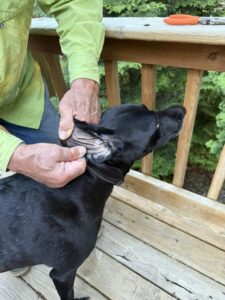
The best way to find ticks on dogs is to feel for unusual bumps with your hands because small deer ticks, especially, are difficult to see in dog fur. The inside of a dog’s ears are especially a vulnerable “tick-target”.
My preferred method of tick removal is using needle-nose pliers, such as those found on a multi-tool which I always have on hand. They work just as effectively as tweezers by grabbing as close to the flesh as possible to properly remove the tick and have the added benefit in performing proper tick disposal. Yep, folks, I sure do enjoy hearing that satisfying “crunch” caused by the pliers applying a final and very thorough touch to the encounter.
Up until about 5 years ago, the only ticks I ever encountered in my Thumb area were the larger dog ticks. Now the vast majority are the smaller deer ticks and discovering them on yourself or your pets requires a very discerning eye and a ready source for tick removal. My four hunting dogs all have long floppy ears which are a prime target for ticks, especially on the underside and in any crack or cranny the ticks can find. My dogs always get a thorough tick inspection, even after a short romp in the yard and farm pond. However, dog fur sometimes makes finding and removing ticks a tad challenging, requiring using my hands to rub over and feel for any unusual small bumps. The dogs don’t mind the extra hands-on attention if the needle-nose-plier-extraction doesn’t include some fine “puppy-fuzz” with the tick!
For free tick identification, email a photo to MDHHS-BUGS@michigan.gov.

than 40 years and has had his weekly radio show, “Tom Lounsbury
Outdoors” for more than 20 years. Tom grew up on a farm in
Michigan’s Thumb, and it is where his first outdoor adventures began
as a kid accompanying visiting pheasant hunters into the field during
the “pheasant hunting heyday” of the 1950’s and 1960’s. It is a passion
he still has to this day and being the 4 th generation to own the family
farm, he has put most of it into conservation programs with a focus on
wild pheasants, which in turn helps all wildlife.
Being an outdoor communicator, Tom appreciates all the outdoor
adventures he experiences in different places, and especially the
people he meets in which to share them.
- Fun times enjoying the family farm pond - July 14, 2026
- Suppressing those sudden loud noises during outdoor shootingadventures - July 14, 2026
- The dependable Jeep, an American icon for 85 years and still ticking - July 14, 2026