
The U.S. military began realizing during the 1930’s that it needed a light reconnaissance vehicle due to the quickly developing atmosphere of modern warfare. The British had been using some tough vehicles made by Austin, but they were two-wheel drive and causing issues during reconnaissance in rough country. It was determined the only way to go would be with a light and compact vehicle which featured four-wheel drive. The German blitzkrieg in 1939 put developing an ideal scouting vehicle into overdrive.
1940 found the Army Quartermaster Corps (QMC) seeking designs and bids from various American automobile manufacturers. The three main competitors were Ford, Willys-Overland and a small company called American Bantam Motors. There was lobbying and a bit of skullduggery taking place to win the government contract, which would mean millions. Bantam came up with the best design, but Army officials (under the guise the data was Army property) allowed the other competitors to review all of Bantam’s technical data, who in turn would create their own versions which were nearly identical to Bantam’s. Being the lowest bidder, Willys-Overland won the contract, and production began in 1941.
There are various theories as to where the name “Jeep” came from. It is said that when Willys-Overland reps were giving rides to politicians up and down the Whitehouse steps with the new reconnaissance vehicle, one of them told a reporter it was a “Jeep”, and so it came out as such in newspapers the next day. It turns out it was a term which goes back to World War I when Army mechanics called any automobile to be tested as being jeeps. There was also the 1930’s cartoon character called “Eugene the Jeep” who could go anywhere.
Because it was a very effective vehicle for scouting activities, it was called a “Peep” by World War II soldiers. It was an extremely versatile and dependable vehicle which could also be armed, even with anti-aircraft guns, and stretchers for transporting the wounded. It was never commonly called a Jeep by soldiers until the Korean War, when Willys-Overland would give it the official name Jeep in 1950.
Willys-Overland was purchased by Kaiser Motors in 1953 which would become the Kaiser-Jeep Corporation in 1963. Kaiser would sell its automobile business to American Motors Corporation (AMC) in 1970, which in turn would be purchased by the Chrysler Corporation in 1987. This is when the “CJ” designation of Jeeps that had been around for years was dropped and the newly designed “Wrangler” came in to being.
My first plunge into four-wheeling was with a brand new 1974 Ford Bronco and truthfully, I have never wanted to be without a 4-wheel drive capability ever since. Like the British military during the 1930’s, I found 2-wheel drive to be a bit lacking for my outdoor lifestyle. However, venturing into 4-wheeling taught me humility right away, because nothing is as stuck as 4-wheel drive when you try to tackle the impossible!
My trusty Bronco had become a beat-up rust-bucket when I purchased a bright red 1986 Jeep CJ 7. It was a very versatile vehicle which even included a snowplow, and I dearly loved to plow snow with it. All three of my sons used that little Jeep to learn how to drive and with a 4-on-the-floor transmission, they learned how to manually shift gears, something many kids don’t know anything about these days. We also shared many outdoor adventures, thanks to the Jeep, and there was the family vacation to the U.P. with all three boys seat-belted into the back seat, and our luggage and gear in a small trailer towed behind.
Then came the moment when my two older sons, Jake and Josh, were in high school and they decided to “transform” the Jeep when I wasn’t home. I knew its hardtop was removable, as were its doors, and that the windshield could be folded over onto the hood. It is just that I liked it the way it was, and yep, folks, I was a bit breathless, but after regaining my emotions I quickly adapted because it’s rugged, “combat ready” look grew on me (I believe my sons thought the transformed Jeep would make a great “chick-mobile”). From that time on, warm weather permitting, the Jeep went frequently about in the transformed mode, a fact the versatile Jeep has always been known for.
There was also the memorable moment when my son Josh was home from college for Christmas, during an ongoing muzzleloader deer season. There was an impending big snowstorm, with snow already coming heavily down at a steady rate when we headed for a likely location to do a 2-person deer drive, which we performed in a leapfrog fashion, by taking turns being the stander or driver. The snowstorm was reaching blizzard proportions when I pushed a fork-horn buck to Josh, which he dropped at near-pointblank range when it busted out of the swirling storm and nearly ran over him.
We quickly tagged and field dressed the buck, and by the time we reached our little red Jeep, a near-blinding blizzard was in full progress. Being only a couple miles from home, we simply threw the buck across the Jeep’s hood, and had to bust through snowdrifts, which were beginning to plug the road, but our dependable little Jeep did its duty!
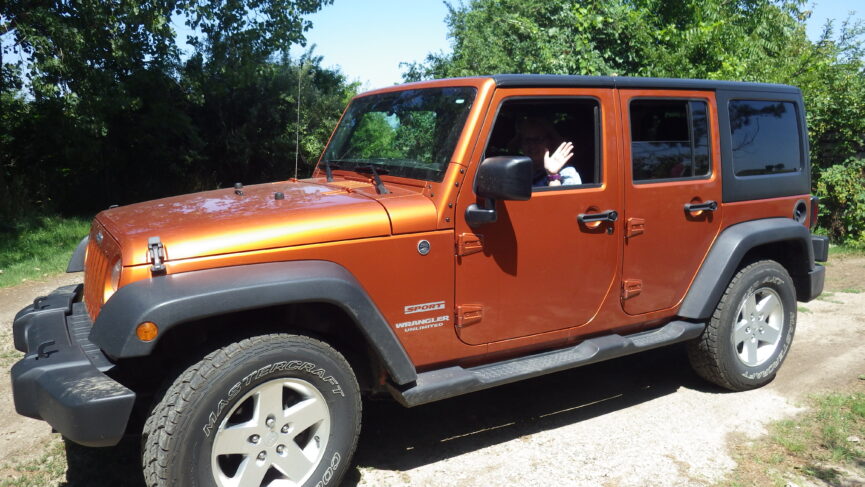
I had the CJ-7 Jeep for over 20 years and eventually, quite sadly, we parted ways when I purchased a 4-wheel drive Jeep Grand Cherokee, which was a great vehicle, but alas, it couldn’t be transformed any and lacked that rustic “Jeep” look I had grown to appreciate. Then 15 years ago, I started frequently seeing the new 4-door Jeep Wrangler around the country, and it certainly perked my interest. I convinced my wife Ginny that we really needed one, and much to my surprise, she agreed. The color we picked is called “Mango Tango”, a coppery orange. The 4-door Wrangler is longer and a bit wider than my old CJ 7, but I see a whole bunch of similarities, including it can be transformed somewhat (the roof can be easily removed in 4 sections). And I have always appreciated a sturdy rollbar for off-road adventures.
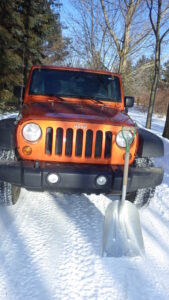
Author’s ‘Jeep’ and accompanying tool to suffice for most any ‘trail’.
Ginny and I soon learned about the “Jeep wave”, where Jeep Wrangler owners usually wave at each other when meeting on the road, which I find as being rather unique and friendly, because it makes you feel like you are all one big family. Like the Jeep ads say, the Wrangler gives you an automatic sense of freedom and adventure, something I believe began with that first successful four-wheel drive, light and compact reconnaissance vehicle.
15 years later, our well-made 2011 Jeep Wrangler still looks good and remains as dependable as ever. Yep, folks, we are not about to go our separate ways, and like its predecessors, it is tough, durable, and ultimately versatile. The basic concept and look are still there, and no doubt are the key reason the Jeep remains an American icon 85 years later.

than 40 years and has had his weekly radio show, “Tom Lounsbury
Outdoors” for more than 20 years. Tom grew up on a farm in
Michigan’s Thumb, and it is where his first outdoor adventures began
as a kid accompanying visiting pheasant hunters into the field during
the “pheasant hunting heyday” of the 1950’s and 1960’s. It is a passion
he still has to this day and being the 4 th generation to own the family
farm, he has put most of it into conservation programs with a focus on
wild pheasants, which in turn helps all wildlife.
Being an outdoor communicator, Tom appreciates all the outdoor
adventures he experiences in different places, and especially the
people he meets in which to share them.
- Fun times enjoying the family farm pond - July 14, 2026
- Suppressing those sudden loud noises during outdoor shootingadventures - July 14, 2026
- The dependable Jeep, an American icon for 85 years and still ticking - July 14, 2026