
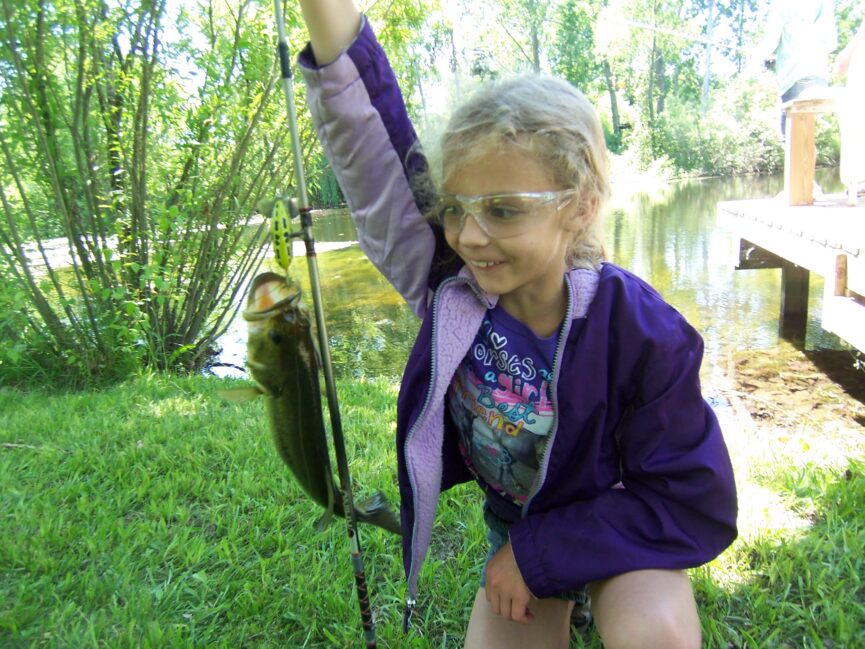
When my wife Ginny and I started building our home in 1976, one of the first things on the agenda was digging a farm pond, and using the resulting dirt to fill in around three sides of the house. I can remember the “pond” being nothing but a large, empty crater in the ground. The first water into it actually came from our new well, and the well-digger had recommended doing so to assure that all the pipes were clear of sediment and any metal fragments.
I had a long hose going from the hydrant at the well to the empty pond when a load of lumber arrived for the house, and the deliveryman began laughing right away when he saw the hose at work, and let me know it was going to take quite a while to fill the pond. He then told several folks in town about my obvious folly, and soon a couple gents came right out to see if it was true and had quite a laugh as well.
Since my making sure the well-pipes were flushed clear was none of these folks’ business, I made no effort at an explanation and let them all have their laugh. I had grown up on this ground, knew it intimately, and there was a reason for the pond’s location, which was in a shallow ravine through the field which funneled the runoff from over 40 acres on the higher ground. I had gotten stuck with a tractor in that location a number of times due to this fact. A couple days after the “hose incident”, some heavy-duty rainstorms hit, and as I had hoped, the new pond quickly became half full.
I had another load of lumber coming a week later, and made a point of running the hose back out to the pond. Yep, folks, let me just say the deliveryman was a bit speechless, especially when I told him that I figured the hose would have the pond topped off in about another week. I never heard anymore rude comments from nosey know-it-alls about my “pond folly”. I guess word travels!
The following year, we purchased fish from a hatchery which included trout, channel catfish, bluegills and largemouth bass, as well as shiners for a food base.
The trout did fine in the pond, but didn’t reproduce and they were eventually fished out. The largemouth bass, catfish and the bluegills, however, did a great job at reproduction and I wouldn’t have to purchase any more fish for the next 30 years. Dealing with the pond during the first 20-odd years had its challenges due to that 40-acre high ground runoff which came from tilled farm ground. While this provided plenty of water annually for the pond, it also contained fertilizer and other chemical residues, and rainstorms made the pond murky.
When we put most of the farm into CRP 25 years ago, I would learn the importance of how prairie grasses literally filter and clean the runoff water going into our pond. It truthfully proved to be a dramatic change in water quality, but I would soon also experience some other dramatic changes to the pond. I had planted quite a few trees around the pond’s perimeter and they had matured to the point that each autumn, plenty of fallen leaves would land and eventually sink into the water and decompose, which depletes the water’s oxygen supply. This in turn, is very detrimental to fish, especially so when the pond is completely iced over. I would experience my first total fish die-off about 20 years ago.
I didn’t realize this was happening at first, because there were no dead fish floating around at ice-out time. I only noticed there were no more fish and was quite puzzled about what was happening. I soon discovered that the fish, like the leaves, would completely decompose under the ice, and breakdown, by the time of the spring thaw. Since I didn’t want to cut down any of the trees I had long watched to grow, I went and bought more fish, which entailed largemouth bass and hybrid bluegills, and they did quite well, at least until the next hard winter came along. I would then experience three complete fish die-offs and buying more fish on a regular basis was getting costly.
I have considered getting an aerator but remain a bit hesitant because the pond sits right in the middle of what I call prime “rabbitat”, and rabbit hunting with my dogs is a favorite winter pastime. An aerator could cause soft spots in the ice which would support a fleeing rabbit but not the pursuing dog.
Several springs ago, figuring I had no more fish in the pond, I asked my son Jake to purchase about 3 dozen “comet” goldfish and a half dozen koi from a pet store in Saginaw, which we released in the pond. I wanted fish of some sort to help naturally control matters by eating mosquito larvae, and the goldfish were a cheaper option, and I assumed they would only die-off during the winter anyway.
Well, folks, I sure assumed wrong. Recent winters have been relatively mild and the goldfish, not to mention the koi, have done quite well, and have multiplied in an amazing fashion. I have even discovered that goldfish and koi will crossbreed, and the resulting hybrids represent some amazing color variations.
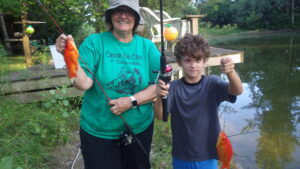
Author’s family showing off their ‘catch’.
Having grandchildren who love to fish, we began to go after the goldfish. This often entails a cane-pole, bobber, and a bit of worm on a small hook. We’ve found which works for catching bluegills also does quite well for goldfish. This was a catch and release affair at first, because I have yet to figure out a “goldfish recipe”. Most of the fish caught are a plump 6 – 14 inches), and I have discovered that goldfish can readily get to be over a foot long if living in the right habitat.
To help control the steadily expanding goldfish population, fish we now catch are frequently transferred to a shallow wildlife pond nearby, to assist in ridding mosquito larvae. As summer progresses, the wildlife pond typically begins to recede, causing the goldfish therein to really group up, which is a gourmet delight for great blue herons, green herons and sandhill cranes, which go on a literal feeding frenzy. This is nature working in a full circle.
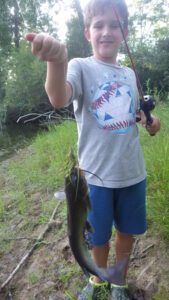
Grandson’s trophy catch in the family’s pond
We have stocked our farm pond with bluegills, large mouth bass and channel catfish, and all are doing quite well, along with the goldfish they feed on. One thing we’ve noticed since creating a “goldfish pond”, is that we’ve have very little algae issues with our pond. Obviously, the goldfish are having an impact. Goldfish and koi do feed on algae and plants, which might be causing matters to be in our favor.
The fact remains, for better or worse, I have unwittingly created a genuine goldfish pond. The key to all this, I believe, is to enjoy what it has to offer.
Yep, folks, it sure beats having no fish at all!

than 40 years and has had his weekly radio show, “Tom Lounsbury
Outdoors” for more than 20 years. Tom grew up on a farm in
Michigan’s Thumb, and it is where his first outdoor adventures began
as a kid accompanying visiting pheasant hunters into the field during
the “pheasant hunting heyday” of the 1950’s and 1960’s. It is a passion
he still has to this day and being the 4 th generation to own the family
farm, he has put most of it into conservation programs with a focus on
wild pheasants, which in turn helps all wildlife.
Being an outdoor communicator, Tom appreciates all the outdoor
adventures he experiences in different places, and especially the
people he meets in which to share them.
- Fun times enjoying the family farm pond - July 14, 2026
- Suppressing those sudden loud noises during outdoor shootingadventures - July 14, 2026
- The dependable Jeep, an American icon for 85 years and still ticking - July 14, 2026