
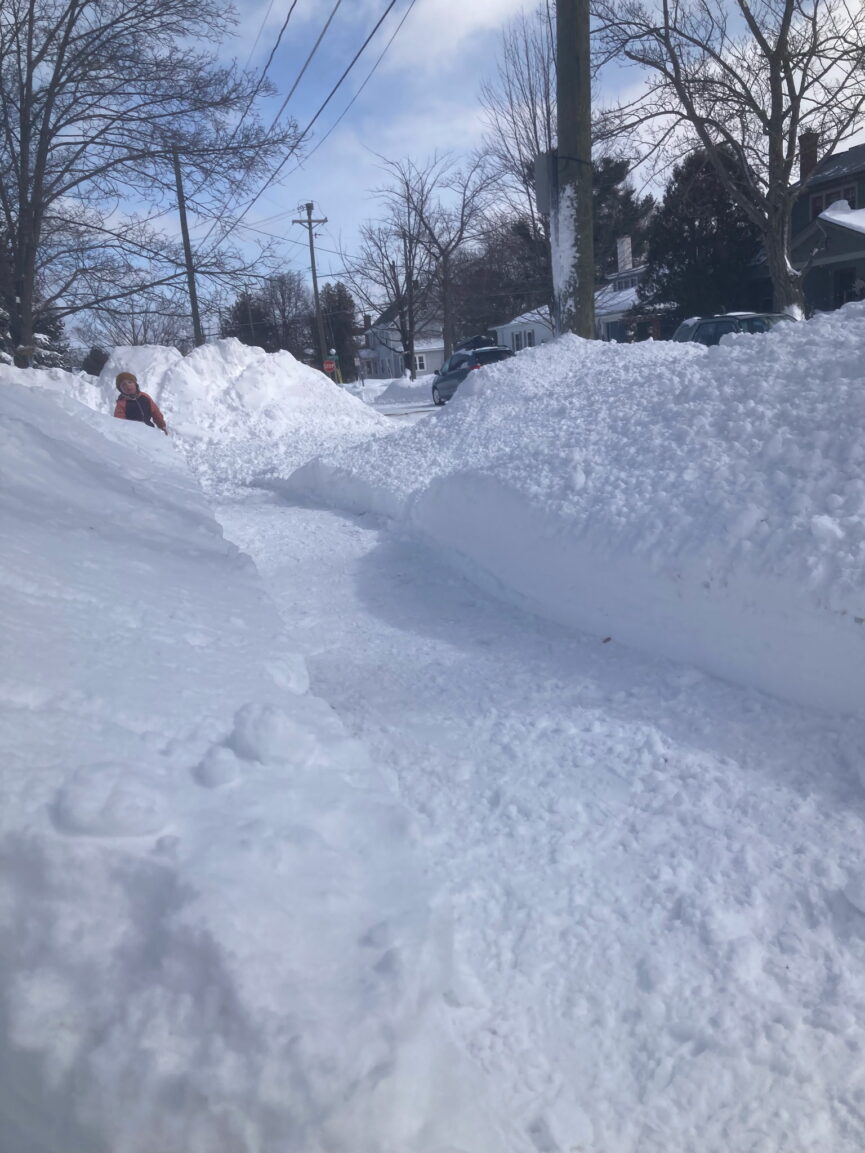
As residents of Michigan, we are no strangers to what winter weather entails. Some years are more difficult than others. It seems that weather can be rather cyclic in nature. Remember the blizzard of 1978? Those who were there sure do. Record snow and high winds throughout the state caused consecutive snow days, remembered fondly by those who were school age at the time. I remember me and my brother being tasked with going to town, 7 miles one way, to pick up groceries for our family on our Alouette snowmobile, something we was more than happy to do. And the winter of ‘26 seems to be competing for this title. Just ask our girls and their families who live in the central to western upper peninsula. And they’ll quickly remind us that “It’s not over yet!”

More snow! Nowhere to go?
In the mix, we’ve also had mild winters with very little snow. Many years ago, I remember finding a dandelion on Christmas Day. Back in 2017, I remember going to the U.P. 200 Dog sled race in Marquette, which is held in February, and temps were in the sixties! People were wearing T-shirts in town, and breweries were opening their outdoor dining areas. Now granted, Yoopers are harder core when it comes to winter weather, but still, that was a year to remember. The year before, we had 3 layers on, standing by one of the portable outdoor warmers, and still froze our heinies off.
So enough about our tolerance to cold weather, or more often, our lack thereof. We have the means to keep ourselves sheltered, comfortable, and fed. Except for the occasional power outage, which happened last year during the historic ice storm, we do okay. Communities come together and help each other out. It’s a beautiful thing to see.
But what about the wildlife forced to endure a long, difficult winter? Their food sources are not always readily available. Hunkering down in extreme temperatures has to use up whatever limited stores of energy they had to start with just to keep them alive as they slowly starve. With compromised health, their immune systems will surely suffer.
My husband, like most outdoorsmen, has a few trail cams strategically placed on our property. He captured this image of what is likely a coyote with the mange.
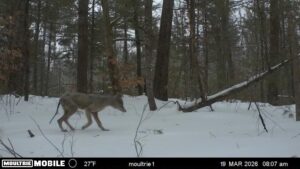
NE Michigan coyote caught on trail camera showing eminent signs of mange
The mange is a devastating skin disease caused by sarcoptes mites that burrow under the skin to lay eggs, causing an allergic reaction. This leads to intense itching, significant hair loss, and thickened skin. We’ve seen foxes and raccoons we suspected had the mange. They appear ragged and emaciated with patchy fur. Extreme itching may cause them to become lethargic and confused, triggering them to enter residential areas during the day, something that would ordinarily be totally out of their character and comfort zone.
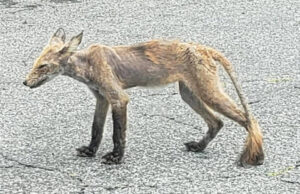
Photo taken by Jen Andretta of Westfield, NJ. The oddity of a daytime, urban appearance of a fox are often signs of disease.
Unfortunately, the mange is highly contagious. Affected animals spread the disease through direct contact or contaminated dens. This risk extends to domestic animals, including the family dog. Because they may approach humans in their altered mental state, it’s possible to transfer this mite to humans, in which case it is referred to as “scabies.” Most often transmitted to humans by dogs, scabies presents as itchy pimples or blisters, usually on the arms, chest, or abdomen where direct exposure to pets occur. This mite cannot fully thrive on human skin to complete its life cycle, so the condition is usually temporary. Dogs do need to be treated, though, for their health and to prevent re-infection and transmission.
The prognosis for wild animals, however, is not so good, especially in the winter when their immune system is weakened. The mange is frequently fatal. Hair loss leads to exposure and hypothermia sealing their fate. Sadly, it’s a slow, painful death as they gradually lose their strength and drive to hunt leading to starvation.
But that’s nature, of course… A continual ebb and flow of challenges that test the resilience of all creatures, with the strong surviving for yet another year of the same. Whether starvation from the effects of disease or lack of available food, or falling victim to predators, or even failed predatorial efforts, this is part of the wonder of wildlife. As it was so well said in a beloved Disney children’s movie… It’s the circle of life!

- THE ICE STORM OF ‘25-ONE YEAR LATER- - March 21, 2026
- THE LONG WINTER AND NATURE’S CONSEQUENCES - March 21, 2026
- TICKS AND LYME DISEASE – “Once Bitten, Twice Shy” - March 6, 2026